

BEDROCK
a foundational mineral, metal & vitamin panel designed to support female physiology
hair tissue mineral analysis + 62 serum biomarkers to map the mineral matrix
Introducing Bedrock,
A foundational six-month container for deep nourishment and vitalization, built around your physiology.
Most mineral balancing programs were designed by men in the 1980s and stop at measuring minerals through Hair Tissue Mineral Analysis. BEDROCK goes further, into the systems that determine how your body actually absorbs, transports and uses those building blocks. We do that by reading your HTMA alongside 62 biomarkers from a serum panel, which lets us see the vitamins and biochemical processes animating your mineral matrix rather than inferring them. The result is a tailored protocol capable of capturing the mineral nuances most impactful to female physiology.
You'll be well held throughout: three consultations, and six months of ongoing support in our HIPAA-compliant portal on Practice Better, where you can drop a question into our thread anytime something comes up. Alongside the biochemistry, we'll work with psycho-spiritual health coaching and nervous system support, expanding the depth of your personal container.

Who does this program serve?
A woman is templated to grow through cycles of expansion and contraction. The descent is not the problem; it's how her body and psyche are designed to move. But every initiatory passage draws down the same reserves, whether it's childbirth, perimenopause, illness or grief, and what she has in the tank when she arrives determines a great deal about how she comes out the other side.
This is terrain theory in practice. A well-nourished body meets its thresholds with more grace, not because nothing hard happens, but because there's something underneath her to meet it with. Building that terrain serves everyone. This program is especially in service to:
anyone desiring to map their mineral matrix to support deep nourishment and root healing
those with a history of disordered eating, under- eating, fad or extreme dieting, vegetarianism, veganism and orthoexia
those navigating complex or chronic illness
those navigating lifespan hormone transitions or imbalances
people who desire support detoxifying heavy metals in a safe way
What sets this program apart from other mineral balancing programs?
Over years of working with women, I came to realize HTMA alone was too blunt an instrument to capture a woman's mineral terrain and the biochemistry that supports it. Most specifically, it couldn't tell me what I needed to know about copper and iron, arguably the two most consequential minerals for a woman's hormonal and lifespan health. So I began recommending serum testing alongside it, to see the terrain that determines how minerals actually move.
The two tests do genuinely different things. Serum bloodwork shows me what hair alone simply cannot: your true iron status, your copper ecology, your inflammatory load, methylation status, and metabolic health. HTMA is probably the best tool we have to capture the epidemic of female burnout, offering a sense of how your body has been perceiving stress, safety and resourcing over a three month window. It also offers archetypical psycho-spiritual insights to host depth explorations.
Read together, through a functional health lens and with female physiology in mind, each test clarifies and corroborates the other. They tell me not just which minerals are off, but why, which is the difference between a supplement list and a protocol that addresses the root.
The frameworks I trained in weren't wrong about minerals mattering. They were just built without the hormonal, methylation and metabolic context that determines what a woman's minerals are actually doing.
.
A well nourished body has robust energy and a clear frequency. It can do the job of managing your metabolism, your hormones, detox pathways, and even your psycho-spiritual health more optimally.
Minerals are the spark plugs of life- alivening our cellular voltage, powering our biochemical pathways, and shaping our molecules of emotion through their affect on hormones and neurotransmitters. Yet these essential elements are easily depleted by environmental burdens and stress, leaving us vulnerable to heavy metal accumulation in their absence. I believe our work in the functional health sphere is to support and advocate for women, whose bodies bear the burden of weaving through world’s largely designed without her unique physiology in mind.
HTMA might in fact be the most precise tool we have in capturing the epidemic of female burnout. Women who have been told their labs are fine through a biomedical lens despite feeling anything but find enormous validation through HTMA data; whether learning they’re in a four low’s pattern, have an extremely low oxidation rate, adrenal exhaustion, or all of the above. Women who seem themselves in through patterns of stress and depletion get granular on where real change and support is needed. They also see themselves through the lens of mineral archetypes and psycho-spiritual patterns in a way that potentiates further self- development, all while healing the mind body-split imposed by the overlords of reductive cartesian rationalism.
Remineralizing the Maternal Matrix
The serum panel includes 62 biomarkers, at a wholesale price of $190 if ordered through Fullscript and drawn at Quest laboratory. Or have your primary care provider run the tests, and simply email me the results.
What serum markers do we assess?
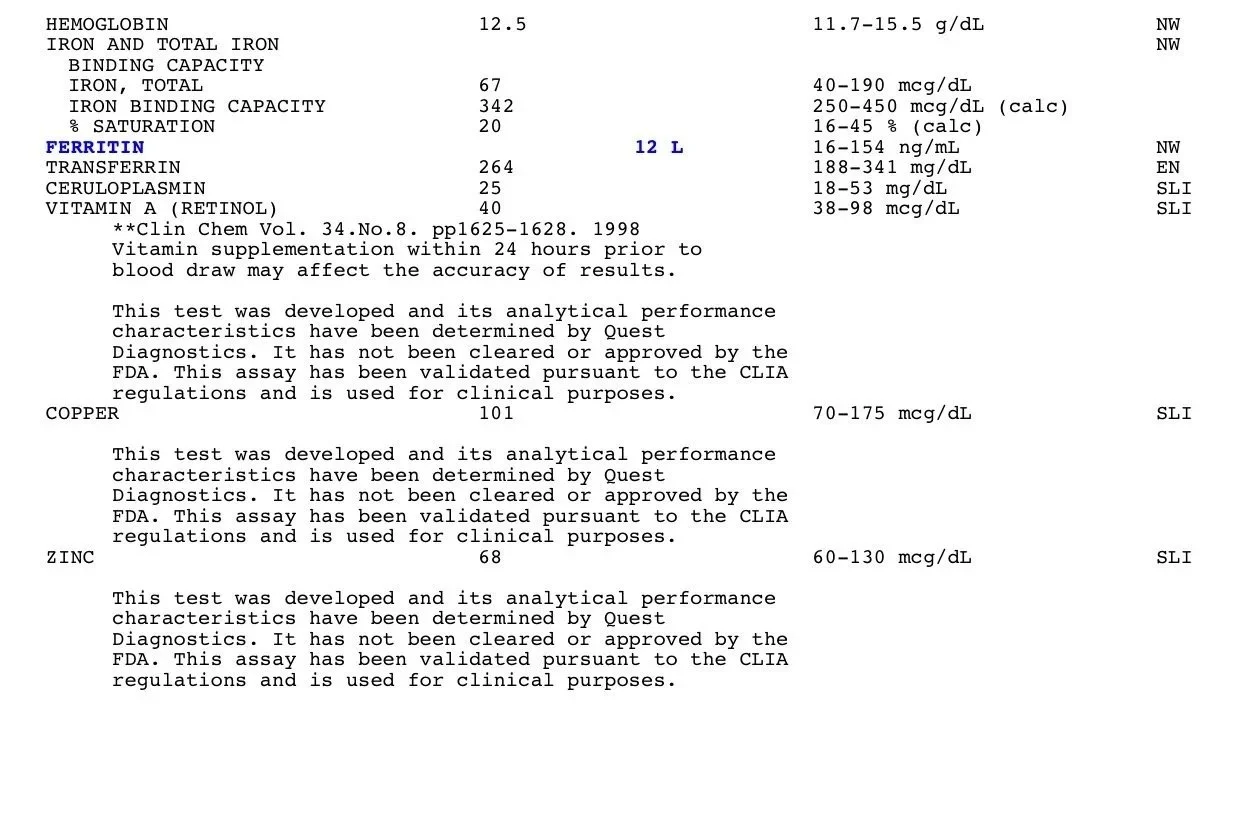
Iron, Total
Ferritin
Total Iron Binding Capacity (TIBC)
Iron % Saturation
Copper, Plasma
Copper, RBC
Ceruloplasmin
Zinc, RBC
Vitamin A (Retinol)
hsCRP: high sensitivity inflammatory marker
Vitamin D, 25-OH, Total
25-OH Hydroxy Vitamin D (Cholecalciferol D3)
25-OH Hydroxy Vitamin D (Ergocalciferol D2)
Homocysteine: methylation marker
Thyroid-Stimulating Hormone
Free T4 Index (T7)
T3, Uptake
T4 (Thyroxine), Total
Glucose, Fasting
Monocytes
Myelocytes (%)
Neutrophils
Nucleated RBC (%)
Promyelocytes (%)
Reactive Lymphocytes
Red Cell Distribution Width (RDW)
Neutrophils (%)
Monocytes (%)
Lymphocytes (%)
Eosinophils (%)
Basophils (%)
Platelet Count
Mean Corpuscular Hemoglobin Concentration (MCHC)
Mean Corpuscular Hemoglobin (MCH)
Mean Corpuscular Volume
Hematocrit
Hemoglobin (HGB)
Band Neutrophils
Blasts
Metamyelocytes
Mean Platelet Volume (MPV)
White Blood Cell Count (WBC)
Red Blood Cell Count (RBC)
The Foundational BEDROCK Package Includes:

Two hair tissue mineral analyses tests, one initial, one retest ($100)
A serum nutrient panel ordered through Fullscript, taken at a Quest lab near you ($200)
*Note, for those with insurance, it may be possible to run labs through your PCP instead of paying out of pocket. Please schedule a 30 min call to discuss how to approach your provider.
A comprehensive onboarding process, building a mulitdimensional picture of your terrain through a health history, diet and lifestyle assessment.
A full review of previous HTMA lab work, and any nutrition testing
1 90 minute initial results and coaching consultation
1 60 minute retest results and coaching consultation
1 60 minute integration + next steps closing call
A comprehensive diet, lifestyle, and supplement protocol PDFs with updates along the way
Six months of text messaging support through our hippa compliant portal Practice Better
25% off Fullscript dispensary
Thats three tests, three consultations and six months of ongoing support
$1200
*payment plans available upon checkout. If you intend to complete blood work through your PCP, please select the “bring your own serum labs.” We can always add on blood work later, if necessary. If you are already on a mineral balancing journey and would just like the serum test, book under “bring your own HTMA" If you have questions about which package is best for you, book a 30 minute call.
How it works
If you have questions, book a resonance call. We decide together whether this is the right starting place, how to approach your PCP for serum tests, and any questions you might have.
Complete your testing and intake paperwork. You’ll receive onboarding paperwork, including a comprehensive diet, lifestyle and health history. You mail your HTMA test from home, and either go to Quest laboratories to complete your blood work or your primary care practitioner.
Receive an invite to book your first consultation when results are in. I’ll take a close look at your paperwork and tests, and reach out when it’s time to book.
We meet to develop your protocol together. You get your interpretation, your priorities, and a protocol you can actually follow that fits your budget and health goals.
Receive six months of support while rebuilding. We do a simple HTMA test after 90 days on your protocol, and on a case by case may do a follow-up blood panel at the end of six months if its available to you.
Why I added serum tests to complete my mineral balancing package
HTMA is a genuinely good instrument for what it does well. It reads relative patterns and ratios inside the cell across a three-month window. It's non-invasive, affordable, and it trends beautifully over time in a way a single morning blood draw never can. I use it in every program I run, and I'm not walking that back.
But there are two minerals I've stopped trusting it to measure, and they happen to be two of the most consequential in women's health.
Iron
The clinically important question is never how much iron is floating around. It's how much you have in reserve, how much is in transit, and whether your body can move it where it's needed next. That story is told by proteins: ferritin, transferrin, TIBC, transferrin saturation. None of them live in a hair shaft.
This matters because iron deficiency and iron overload are both real, and they call for opposite responses. It matters more because iron deficiency is one of the most common nutrient deficiencies in menstruating women, and because deficiency has several distinct roots. Is she not taking enough in? Not absorbing what she takes in? Losing too much every cycle? Or is inflammation holding her iron in her tissues and out of circulation, so her ferritin reads reassuringly normal while she feels anything but? Those four situations look similar from the outside and need entirely different support.
Dr. Eck's mineral balancing framework largely assumes iron excess. It doesn't screen for deficiency, and there's no iron in any of the supplement lines. For a protocol built around the word “balancing”, that's a strange asymmetry. And for women specifically, it means the most common iron problem we have is the one the framework isn't looking for.
So we measure it properly: ferritin, total iron, TIBC and transferrin saturation, alongside a complete blood count and high-sensitivity CRP. The CRP is not optional. I never read a ferritin without an inflammatory marker beside it, because inflammation is precisely what makes a depleted woman's ferritin look normal. That single pairing is often the difference between finding a deficiency and missing it entirely. We also assess iron recyling by properly assessing copper, another mineral HTMA alone does not map or support well.
Copper
With copper, the number that matters isn't how much you have. It's how your copper is bound.
Most of the copper in your blood is held safely inside ceruloplasmin, doing its job. A smaller fraction rides loosely on other carriers, and that loosely bound pool is the one capable of driving oxidative damage when things tip. Two women can carry identical total copper and completely different amounts of the reactive kind.
That distinction is the entire clinical question, and a hair test cannot make it. Hair copper can read low, normal or high and still tell you nothing about how your copper is bound, or whether your ceruloplasmin is functioning as it should.
So we measure it properly: ceruloplasmin, serum copper, zinc and vitamin A, the last two being the cofactors copper depends on for binding and transport. Then we read those against the conditions that push copper toward the reactive pool: hsCRP for inflammatory load, ALT for liver function, and fasting glucose, because chronically elevated blood sugar damages ceruloplasmin's grip on copper directly.
What else we look at, and why
Metabolic health. Traditional HTMA reads your calcium-to-magnesium ratio as a proxy for how well you tolerate carbohydrates. It's a reasonable inference, but it is an inference, and that ratio moves for a dozen reasons that have nothing to do with blood sugar. Fasting glucose and thyroid markers give us the real thing instead of painting with broad strokes. Thyroid function sets your metabolic rate, your gut motility, and how efficiently minerals get used at the cellular level, and thyroid dysfunction is both a cause and a consequence of mineral imbalance. Fasting glucose does double duty here: metabolic health in its own right, and a direct read on one of the mechanisms that turns your copper reactive.
Methylation. Homocysteine tells us how your methylation and detox pathways are running, and for a woman that pathway sits at a crossroads. It governs how you clear estrogen and histamine. And it governs how tissue copper is released through bile, which is copper's main exit route. Estrogen raises copper. Histamine and copper drive each other. So a methylation bottleneck doesn't just slow one thing down, it backs up three systems that are already entangled in a female body, and the mineral picture shifts with them.
These nuances is what makes the BEDROCK panel female-bodied rather than generic.
Our inner ecology, environment, and experience of ourselves are interrelated dimensions. Tending our inner landscape promotes foundational healing, so we can step into our deepest, most authentic and vitalized embodiment. Tending our inner ecology is the future- writing technology we need in times of individual and collective change.
